Buy forumtrzeciegowieku.pl ?
We are moving the project
forumtrzeciegowieku.pl .
Are you interested in purchasing the domain
forumtrzeciegowieku.pl ?
domain@kv-gmbh.de · 0541-91531010
Buy forumtrzeciegowieku.pl ?
When do I use get/got and became/become in English grammar?
You use "get/got" when you want to indicate the process of obtaining something or experiencing a change in condition. For example, "I got a new job" or "She got sick." On the other hand, you use "became/become" when you want to indicate a change in state or condition. For example, "He became a doctor" or "She has become more confident." **
How is the use of verbs and nouns explained in English grammar?
In English grammar, verbs are used to indicate actions, processes, or states of being. They are the main part of a sentence and can be conjugated to show different tenses, moods, and voices. Nouns, on the other hand, are used to identify people, places, things, or ideas. They can function as the subject or object of a sentence and can be singular or plural. Understanding the use of verbs and nouns is essential for constructing clear and effective sentences in English. **

Similar search terms for English-Grammar-in-Use
Top-Angebote
Products related to English-Grammar-in-Use:
-
Collins Easy Learning English Grammar And Punctuation 1 By Collins Education - Non Fiction - PaperbackTitle:. Collins Easy Learning English Grammar And Punctuation 1 Format: Paperback Overview:. The Collins Easy Learning English Grammar And Punctuation 1 delivers a focused, highly practical introduction to the foundational rules that govern effective written English. Published by Collins Education, this volume serves as the first entry in a widely respected instructional series designed to break down complex linguistic concepts into manageable, easy-to-follow lessons. Rather than presenting dense theoretical lectures, the book adopts a structured, activity-driven approach that guides readers through essential grammar topics, punctuation conventions, clause construction, and common syntactical patterns. Each chapter pairs clear explanations with targeted exercises that reinforce understanding through immediate application. The layout prioritises readability, using spacious margins, defined headings, and visual cues that make self-directed study straightforward. Whether you are preparing for formal assessments, rebuilding foundational literacy skills after years away from academia, or simply aiming to eliminate recurring errors in everyday documents, this guide provides a reliable pathway to clearer, more confident writing. By combining curriculum-aligned content with proven pedagogy, the book bridges the gap between passive reading and active mastery, ensuring that every lesson translates directly into improved communication habits outside the page. What Makes This Book Stand Out:. Unlike traditional grammar textbooks that overwhelm readers with exhaustive terminology and rigid formatting, this volume thrives on accessibility and progressive skill building. The standout feature is its deliberate pacing: each rule is introduced through a concise explanation, immediately followed by contextual examples that mirror real-world usage. Practice tasks are embedded throughout rather than quarantined at the end, allowing readers to test comprehension in the moment and receive structured feedback loops. The editorial design intentionally avoids decorative clutter, keeping attention fixed on syntax, punctuation marks, sentence boundaries, and error correction strategies. Every chapter concludes with review checkpoints that help learners identify weak spots before advancing, creating a cumulative mastery model instead of fragmented studying. The paperback format remains deliberately compact without sacrificing depth, striking a balance between portability and comprehensive coverage. This combination of cognitive scaffolding, clear typographic hierarchy, and purposeful exercise sequencing transforms what could easily feel mechanical into an engaging, results-oriented study tool. It respects the reader’s time, acknowledges typical stumbling blocks, and replaces confusion with repeatable frameworks that stick. Who This Book Is Perfect For:. This resource is ideally suited for secondary school students navigating National Curriculum expectations, particularly...7,99 £*Shipping: 2,99 £Secure redirect to the provider
-
Collins KS2 KS2 Sats Question Book Collection 5 Books Set Age 10-11 (English Reading, English Grammar Punctuation and Spelling)Description. Titles in this Set:. KS2 English Reading SATs Question Book. KS2 English Grammar, Punctuation and Spelling SATs Question Book. KS2 English Spelling SATs Question Book. KS2 Maths Arithmetic SATs Question Book. KS2 Maths Reasoning SATs Question Book. Condition: BRAND NEW. Format:Paperback. ISBN: 9789124249236. KS2 English Reading SATs Question Book:. Get ready for SATs with targeted practice questions.Boost children’s test-taking confidence by using the realistic SATs-style questions included in this Key Stage 2 English SATs Question Book by Collins. Specifically designed to get children ready for the English Reading SAT, this book covers all the content and skills that children will be tested on. A variety of reading texts (such as fiction, non-fiction and poetry) give children a chance to practise all kinds of reading skills.. KS2 English Grammar, Punctuation and Spelling SATs Question Book:. Get ready for SATs with targeted practice questions. Boost children’s test-taking confidence by using the realistic SATs-style questions included in this Key Stage 2 English SATs Question Book by Collins. Specifically designed to get children ready for the Grammar, Punctuation and Spelling SAT (Paper 1), this book covers all the content and skills that children will be tested on.. KS2 English Spelling SATs Question Book:. Get ready for SATs with targeted practice questions.Boost children’s test-taking confidence by using the realistic SATs-style questions included in this Key Stage 2 English SATs Question Book by Collins. Specifically designed to get children ready for the Spelling SAT (Paper 2), this book covers all the content and skills that children will be tested on.. KS2 Maths Arithmetic SATs Question Book:. Get ready for SATs with targeted practice questions. Boost children’s test-taking confidence by using the realistic SATs-style questions included in this Key Stage 2 Maths SATs Question Book by Collins. Specifically designed to get children ready for the Maths Arithmetic SAT (Paper 1), this book covers all the content and skills that children will be tested on.. KS2 Maths Reasoning SATs Question Book:. Get ready for SATs with targeted practice questions.Boost children’s test-taking confidence by using the realistic SATs-style questions included in this Key Stage 2 Maths SATs Question Book by Collins. Specifically designed to get children ready for the Maths Reasoning SAT (Papers 2 and 3), this book covers all the content and skills that children will be tested on.. Title. KS2 Sats Question Book Collection 5 Books Set Age 10-11 (English Reading, English Grammar Punctuation and Spelling). Delivery. Content. Reviews99,99 £*Shipping: 0,00 £Secure redirect to the provider
-
Kyle Books Grammar For Grown Ups: Essential Guide To English Writing - Non Fiction - PaperbackTitle:. Grammar for Grown-ups: Everything you need to know but never learnt in school Format: Paperback Overview:. Mastering the nuances of written communication is one of the most significant advantages an adult can cultivate in both their professional and personal life. 'Grammar for Grown-ups: Everything you need to know but never learnt in school' serves as the definitive bridge across the often frustrating gap between traditional classroom learning and the demanding reality of everyday English writing. As an Essential Guide to English Writing, this volume is crafted specifically for mature readers who recognise that while school may have introduced basic concepts, true mastery requires a deeper, more practical understanding tailored to real-world application. The book addresses the subtle complexities, frequent pitfalls, and stylistic choices that dictate how clearly and persuasively an individual can convey their message. By focusing on the functional aspects of grammar that truly matter outside the exam hall, this paperback volume empowers readers to eliminate uncertainty and communicate with precision. Many adults find themselves relying on autocorrect or second-guessing their phrasing when the stakes are high; this guide eliminates that hesitation by delivering straightforward, applicable wisdom without unnecessary academic jargon. It reinforces the idea that great writing is not about memorising obscure rules but about building trust through clarity. From enhancing the impact of daily emails to refining creative projects, the principles within are designed to be immediately useful. This edition stands as a robust resource for anyone eager to transform potential awkwardness into eloquence, ensuring that every written interaction reflects the sophistication and attention to detail that adulthood demands. What Makes This Book Stand Out:. The distinction of 'Grammar for Grown-ups' lies in its candid approach to the educational shortcomings that many learners face. Unlike standard academic textbooks that can feel detached from daily use, this guide honours its subtitle by tackling the very elements that seem to vanish after the school gates close. The standout philosophy prioritises practical utility over pedantic rigidity, recognising that grammar is ultimately a tool for effective connection rather than a set of arbitrary restrictions meant to confuse. Readers quickly discover that the focus shifts towards making informed decisions about usage, punctuation, and syntax in a manner that supports readability and intent. This perspective demystifies what many consider difficult rules, reframing them as strategies for clarity and respect for the reader's time. Additionally, the book addresses the modern evolution of language, acknowledging how digital platforms and informal messaging require adaptability. It helps grown-ups navigate these shifting landscapes without sacrificing core standards, striking an optimal balance between flexibility and...12,99 £*Shipping: 2,99 £Secure redirect to the provider
-
DK Help Your Kids with English Ages 10–16 – KS3 & KS4 Grammar, Writing & Revision GuideIf English is sounding like a foreign language, make it easy and effortless with the ultimate study guide. This visual reference book takes you through all the different parts of the English language, leaving you ready to help your children tackle the trickiest of subjects. Carol Vorderman's unique study aid encourages parents and children to work together as a team to understand and use all aspects of the English language, including grammar, punctuation, and spelling.This latest title in the best-selling Help Your Kids series combines pictures, diagrams, instructions, and examples to cover the components of the school syllabus, while building knowledge, boosting confidence, and aiding understanding. With your support, children can overcome the challenges of English, leaving them calm, confident, and exam ready.9,99 £*Shipping: 2,99 £Secure redirect to the provider


-
Where is the grammar mistake in English?
The grammar mistake in English is in the sentence structure, verb tense, subject-verb agreement, punctuation, or word usage. It can occur when the sentence is not properly structured, when the verb tense does not match the subject, when there is a lack of agreement between the subject and verb, when there are punctuation errors, or when the wrong word is used in a sentence. Identifying and correcting grammar mistakes is important for clear and effective communication in English. **
-
Are these tasks completely wrong in English grammar?
Yes, these tasks are completely wrong in English grammar. The sentences are fragmented and lack proper structure. They contain errors in subject-verb agreement, punctuation, and capitalization. It is important to ensure that sentences are correctly constructed in order to effectively communicate in English. **
-
When do you use "does" in grammar?
"We use 'does' in grammar when forming questions and negative sentences in the present simple tense for third person singular subjects (he, she, it). For example, 'Does she like ice cream?' or 'He does not want to go to the party.' 'Does' is also used in emphatic statements to add emphasis or to show surprise, such as 'She does love to dance!'" **
-
What does "the by agent" mean in English grammar?
"In English grammar, 'the by agent' refers to the person or thing that performs the action in a passive sentence. It is typically introduced by the preposition 'by' and follows the verb. For example, in the sentence 'The book was written by the author,' 'the author' is the by agent because they are the one who performed the action of writing the book." **


What is the correct grammar for compliments in English?
The correct grammar for compliments in English involves using adjectives to describe the person or thing being complimented. For example, you might say "You look beautiful" or "That was a fantastic performance." It's important to use the appropriate adjectives to convey sincerity and specificity in your compliments. Additionally, using polite language and a friendly tone can enhance the impact of your compliments. **
What is the correct grammar for "Schwerbehindertenausweis" in English?
The correct grammar for "Schwerbehindertenausweis" in English is "severely disabled person's pass" or "severely disabled person's ID card." This term refers to a document that certifies a person's severe disability status in Germany. When translating this term into English, it is important to convey the meaning accurately while also using proper grammar and syntax. **
Top-Angebote
Products related to English-Grammar-in-Use:
-
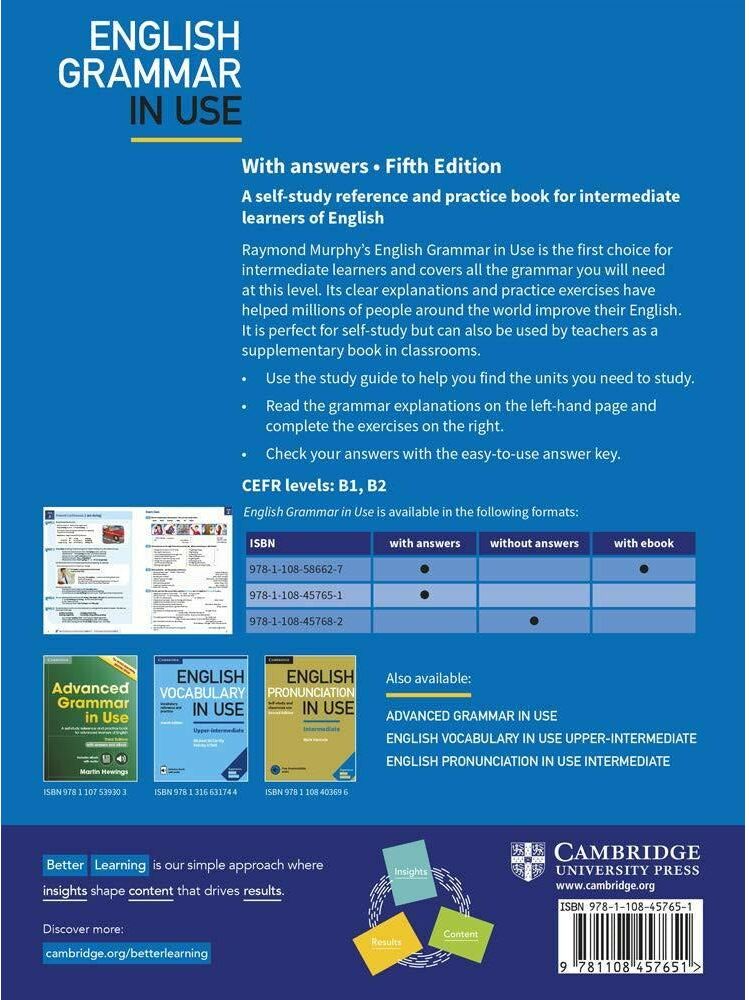
Cambridge University Press English Grammar in Use with Answers by Raymond Murphy – Self-Study Grammar Book for Intermediate LearnersEnglish Grammar in Use with Answers; authored by Raymond Murphy; is the first choice for intermediate (B1-B2) learners and covers all the grammar required at this level. It is a self-study book with simple explanations and lots of practice exercises; and has helped millions of people around the world to communicate in English. It is also trusted by teachers and can be used as a supplementary text in classrooms.12,49 £*Shipping: 2,99 £Secure redirect to the provider
-
English Grammar in Use With Answers for Intermediate Learners by Raymond Murphy - Non Fiction - PaperbackTitle:. English Grammar In Use With Answers For Intermediate Learners By Raymond Murphy Condition: BRAND NEW. Format: Paperback. ISBN: 9783125354241 Overview:. Raymond Murphy's English Grammar in Use with Answers is the definitive self-study reference for intermediate learners working at CEFR levels B1 to B2. In this paperback, clear grammar explanations sit beside abundant practice, guiding you from fundamental rules to real-life usage with growing confidence. It is designed for solo study as well as classroom support, offering a reliable path through tense forms, modals, questions, conditionals, and sentence structure. The edition includes a built-in answer key, enabling immediate feedback so you can monitor progress without a tutor. Built on Murphy’s trusted method—practical, learner-centred, and progression-focused—the book uses a clean, modern layout that makes even complex points approachable. For busy learners, the compact pages and logical progression invite steady daily practice, turning study time into tangible improvements in both spoken and written English. This is more than a reference; it’s a practical toolkit that helps you apply grammar with fluency in real conversations and assignments. Whether you’re preparing for exams, polishing workplace communication, or restarting language study, this book keeps you on track with clear milestones and measurable progress. What Makes This Book Stand Out:. This book stands out for its learner-centred design: every grammar point is introduced with a concise explanation, followed by carefully structured practice built on authentic, real-life examples. The self-study format gives you control over pace and focus, allowing you to revisit topics as needed and build lasting confidence. Because this edition includes answers, you benefit from an immediate feedback loop that reinforces learning and sustains motivation between lessons. Murphy’s layout and typography are deliberately chosen to reduce cognitive load, so even tricky areas feel manageable rather than daunting. The blend of practical usage with deliberate, spaced practice helps you internalise patterns and apply rules naturally in conversations, emails, and written work. This volume reflects a long-standing commitment to clarity, results, and steady progress for learners aiming to achieve real fluency. Who This Book Is Perfect For:. This book is tailored for intermediate learners seeking a solid grammar foundation for daily use and progression toward higher-level study. It suits students preparing for work environments, language certificates, or university study, and adults returning to English after a break. Teachers can rely on it as a dependable classroom companion, while self-mufficient learners will value its clear explanations and structured practice. If you want a reliable, portable reference that helps you master tense, modals, questions, and sentence structure in practical contexts, this is the right choice. It’s ideal for those who...12,49 £*Shipping: 2,99 £Secure redirect to the provider
-
Collins Easy Learning English Grammar And Punctuation 1 By Collins Education - Non Fiction - PaperbackTitle:. Collins Easy Learning English Grammar And Punctuation 1 Format: Paperback Overview:. The Collins Easy Learning English Grammar And Punctuation 1 delivers a focused, highly practical introduction to the foundational rules that govern effective written English. Published by Collins Education, this volume serves as the first entry in a widely respected instructional series designed to break down complex linguistic concepts into manageable, easy-to-follow lessons. Rather than presenting dense theoretical lectures, the book adopts a structured, activity-driven approach that guides readers through essential grammar topics, punctuation conventions, clause construction, and common syntactical patterns. Each chapter pairs clear explanations with targeted exercises that reinforce understanding through immediate application. The layout prioritises readability, using spacious margins, defined headings, and visual cues that make self-directed study straightforward. Whether you are preparing for formal assessments, rebuilding foundational literacy skills after years away from academia, or simply aiming to eliminate recurring errors in everyday documents, this guide provides a reliable pathway to clearer, more confident writing. By combining curriculum-aligned content with proven pedagogy, the book bridges the gap between passive reading and active mastery, ensuring that every lesson translates directly into improved communication habits outside the page. What Makes This Book Stand Out:. Unlike traditional grammar textbooks that overwhelm readers with exhaustive terminology and rigid formatting, this volume thrives on accessibility and progressive skill building. The standout feature is its deliberate pacing: each rule is introduced through a concise explanation, immediately followed by contextual examples that mirror real-world usage. Practice tasks are embedded throughout rather than quarantined at the end, allowing readers to test comprehension in the moment and receive structured feedback loops. The editorial design intentionally avoids decorative clutter, keeping attention fixed on syntax, punctuation marks, sentence boundaries, and error correction strategies. Every chapter concludes with review checkpoints that help learners identify weak spots before advancing, creating a cumulative mastery model instead of fragmented studying. The paperback format remains deliberately compact without sacrificing depth, striking a balance between portability and comprehensive coverage. This combination of cognitive scaffolding, clear typographic hierarchy, and purposeful exercise sequencing transforms what could easily feel mechanical into an engaging, results-oriented study tool. It respects the reader’s time, acknowledges typical stumbling blocks, and replaces confusion with repeatable frameworks that stick. Who This Book Is Perfect For:. This resource is ideally suited for secondary school students navigating National Curriculum expectations, particularly...7,99 £*Shipping: 2,99 £Secure redirect to the provider
-
Collins KS2 KS2 Sats Question Book Collection 5 Books Set Age 10-11 (English Reading, English Grammar Punctuation and Spelling)Description. Titles in this Set:. KS2 English Reading SATs Question Book. KS2 English Grammar, Punctuation and Spelling SATs Question Book. KS2 English Spelling SATs Question Book. KS2 Maths Arithmetic SATs Question Book. KS2 Maths Reasoning SATs Question Book. Condition: BRAND NEW. Format:Paperback. ISBN: 9789124249236. KS2 English Reading SATs Question Book:. Get ready for SATs with targeted practice questions.Boost children’s test-taking confidence by using the realistic SATs-style questions included in this Key Stage 2 English SATs Question Book by Collins. Specifically designed to get children ready for the English Reading SAT, this book covers all the content and skills that children will be tested on. A variety of reading texts (such as fiction, non-fiction and poetry) give children a chance to practise all kinds of reading skills.. KS2 English Grammar, Punctuation and Spelling SATs Question Book:. Get ready for SATs with targeted practice questions. Boost children’s test-taking confidence by using the realistic SATs-style questions included in this Key Stage 2 English SATs Question Book by Collins. Specifically designed to get children ready for the Grammar, Punctuation and Spelling SAT (Paper 1), this book covers all the content and skills that children will be tested on.. KS2 English Spelling SATs Question Book:. Get ready for SATs with targeted practice questions.Boost children’s test-taking confidence by using the realistic SATs-style questions included in this Key Stage 2 English SATs Question Book by Collins. Specifically designed to get children ready for the Spelling SAT (Paper 2), this book covers all the content and skills that children will be tested on.. KS2 Maths Arithmetic SATs Question Book:. Get ready for SATs with targeted practice questions. Boost children’s test-taking confidence by using the realistic SATs-style questions included in this Key Stage 2 Maths SATs Question Book by Collins. Specifically designed to get children ready for the Maths Arithmetic SAT (Paper 1), this book covers all the content and skills that children will be tested on.. KS2 Maths Reasoning SATs Question Book:. Get ready for SATs with targeted practice questions.Boost children’s test-taking confidence by using the realistic SATs-style questions included in this Key Stage 2 Maths SATs Question Book by Collins. Specifically designed to get children ready for the Maths Reasoning SAT (Papers 2 and 3), this book covers all the content and skills that children will be tested on.. Title. KS2 Sats Question Book Collection 5 Books Set Age 10-11 (English Reading, English Grammar Punctuation and Spelling). Delivery. Content. Reviews99,99 £*Shipping: 0,00 £Secure redirect to the provider
-
When do I use get/got and became/become in English grammar?
You use "get/got" when you want to indicate the process of obtaining something or experiencing a change in condition. For example, "I got a new job" or "She got sick." On the other hand, you use "became/become" when you want to indicate a change in state or condition. For example, "He became a doctor" or "She has become more confident." **
-
How is the use of verbs and nouns explained in English grammar?
In English grammar, verbs are used to indicate actions, processes, or states of being. They are the main part of a sentence and can be conjugated to show different tenses, moods, and voices. Nouns, on the other hand, are used to identify people, places, things, or ideas. They can function as the subject or object of a sentence and can be singular or plural. Understanding the use of verbs and nouns is essential for constructing clear and effective sentences in English. **
-
Where is the grammar mistake in English?
The grammar mistake in English is in the sentence structure, verb tense, subject-verb agreement, punctuation, or word usage. It can occur when the sentence is not properly structured, when the verb tense does not match the subject, when there is a lack of agreement between the subject and verb, when there are punctuation errors, or when the wrong word is used in a sentence. Identifying and correcting grammar mistakes is important for clear and effective communication in English. **
-
Are these tasks completely wrong in English grammar?
Yes, these tasks are completely wrong in English grammar. The sentences are fragmented and lack proper structure. They contain errors in subject-verb agreement, punctuation, and capitalization. It is important to ensure that sentences are correctly constructed in order to effectively communicate in English. **
Similar search terms for English-Grammar-in-Use
-
Kyle Books Grammar For Grown Ups: Essential Guide To English Writing - Non Fiction - PaperbackTitle:. Grammar for Grown-ups: Everything you need to know but never learnt in school Format: Paperback Overview:. Mastering the nuances of written communication is one of the most significant advantages an adult can cultivate in both their professional and personal life. 'Grammar for Grown-ups: Everything you need to know but never learnt in school' serves as the definitive bridge across the often frustrating gap between traditional classroom learning and the demanding reality of everyday English writing. As an Essential Guide to English Writing, this volume is crafted specifically for mature readers who recognise that while school may have introduced basic concepts, true mastery requires a deeper, more practical understanding tailored to real-world application. The book addresses the subtle complexities, frequent pitfalls, and stylistic choices that dictate how clearly and persuasively an individual can convey their message. By focusing on the functional aspects of grammar that truly matter outside the exam hall, this paperback volume empowers readers to eliminate uncertainty and communicate with precision. Many adults find themselves relying on autocorrect or second-guessing their phrasing when the stakes are high; this guide eliminates that hesitation by delivering straightforward, applicable wisdom without unnecessary academic jargon. It reinforces the idea that great writing is not about memorising obscure rules but about building trust through clarity. From enhancing the impact of daily emails to refining creative projects, the principles within are designed to be immediately useful. This edition stands as a robust resource for anyone eager to transform potential awkwardness into eloquence, ensuring that every written interaction reflects the sophistication and attention to detail that adulthood demands. What Makes This Book Stand Out:. The distinction of 'Grammar for Grown-ups' lies in its candid approach to the educational shortcomings that many learners face. Unlike standard academic textbooks that can feel detached from daily use, this guide honours its subtitle by tackling the very elements that seem to vanish after the school gates close. The standout philosophy prioritises practical utility over pedantic rigidity, recognising that grammar is ultimately a tool for effective connection rather than a set of arbitrary restrictions meant to confuse. Readers quickly discover that the focus shifts towards making informed decisions about usage, punctuation, and syntax in a manner that supports readability and intent. This perspective demystifies what many consider difficult rules, reframing them as strategies for clarity and respect for the reader's time. Additionally, the book addresses the modern evolution of language, acknowledging how digital platforms and informal messaging require adaptability. It helps grown-ups navigate these shifting landscapes without sacrificing core standards, striking an optimal balance between flexibility and...12,99 £*Shipping: 2,99 £Secure redirect to the provider
-
DK Help Your Kids with English Ages 10–16 – KS3 & KS4 Grammar, Writing & Revision GuideIf English is sounding like a foreign language, make it easy and effortless with the ultimate study guide. This visual reference book takes you through all the different parts of the English language, leaving you ready to help your children tackle the trickiest of subjects. Carol Vorderman's unique study aid encourages parents and children to work together as a team to understand and use all aspects of the English language, including grammar, punctuation, and spelling.This latest title in the best-selling Help Your Kids series combines pictures, diagrams, instructions, and examples to cover the components of the school syllabus, while building knowledge, boosting confidence, and aiding understanding. With your support, children can overcome the challenges of English, leaving them calm, confident, and exam ready.9,99 £*Shipping: 2,99 £Secure redirect to the provider
-
CGP Books CGP KS3 Revision Guides 4 Books Collection Set (English, Spelling, Punctuation & Grammar, Maths & Science)Description. Titles in the Set:. New KS3 Spelling, Punctuation & Grammar Revision Guide. New KS3 English Revision Guide. New KS3 Maths Revision Guide – Foundation Level. New KS3 Science Revision Guide – Foundation Level. Condition: BRAND NEW. Format: Paperback. ISBN: 9781988029498. New KS3 Spelling, Punctuation & Grammar Revision Guide:. This Revision Guide is ideal for helping students master Spelling, Punctuation and Grammar at Key Stage Three. It's bursting with clear, friendly notes explaining all the crucial SPaG skills, with questions at the end of every topic and Knowledge Organisers to help sum up the key information.. New KS3 English Revision Guide:. This smashing KS3 English Revision Guide contains clear, friendly notes and a diverse range of texts to explain every important topic. What's more, we've included knowledge organiser pages to help summarise the key information and solidify everything you've learnt.. New KS3 Maths Revision Guide – Foundation Level:. This fantastic Revision Guide explains everything students need to know for Key Stage Three Maths.. Every topic is explained with clear, friendly notes and worked examples. Plus, there's a range of practice questions to test all those important skills - ideal for students working at a foundation level.. We've even included terrific online video solutions and digital quizzes that can be accessed via QR codes, as well as a free Online Edition of the whole book - brilliant!. New KS3 Science Revision Guide – Foundation Level:. This smashing KS3 Science Revision Guide is ideal for students working at a foundation level.. Every topic is explained with clear notes, diagrams and examples. Plus, there are practice questions throughout - perfect for putting your Science knowledge to the test!. There's even a selection of handy online video solutions and digital quizzes (just follow the QR codes), as well as a free Online Edition of the whole book - brilliant!. Title. CGP KS3 Revision Guides 4 Books Collection Set (English, Spelling, Punctuation & Grammar, Maths & Science). Delivery. Content. Reviews99,99 £*Shipping: 0,00 £Secure redirect to the provider
-
CGP Books KS2 English SAT Buster: Grammar, Punctuation And Spelling 4 Books Collection Set - Non Fiction - PaperbackTitles in This Set:. KS2 English SAT Buster - Grammar. KS2 English SAT Buster: Punctuation Book 1. KS2 English SAT Buster: Spelling Book 1. KS2 English SAT Buster - Grammar, Punctuation and Spelling Answer Book Condition: BRAND NEW. Format: Paperback. ISBN: Overview:. Welcome to a focused, friendly route to KS2 English success with CGP’s KS2 English SAT Buster four-book collection. This BRAND NEW paperback set brings together essential practice for grammar, punctuation, and spelling, plus a dedicated answer book to accelerate progress. Each title is designed for Year 6 pupils preparing for the KS2 SATs, delivering bite-sized, SATS-style questions that target the exact techniques pupils will meet in the exam. The Grammar book walks students through sentence structure, parts of speech, and core rules with clear explanations and lively activities. The Punctuation book covers commas, apostrophes, quotation marks, hyphens and more, all presented in approachable chunks. The Spelling book reinforces vital rules and high-frequency words through varied drills. Finally, the Answer Book provides clear solutions and marking guidance to help learners and caregivers track improvement. Together, these four books form a coherent revision pathway that builds confidence, reinforces learning, and helps pupils reach their best possible SATs score. What Makes This Collection Special:. This collection stands out by delivering a complete, age-appropriate revision toolkit in one purchase. Rather than hunting for scattered resources, families and classrooms get a uniform, reliable set that reinforces the same approach across grammar, punctuation, and spelling. The clear, friendly CGP voice guides learners step by step, turning tricky rules into manageable tasks. The SATs-style practice mirrors the exam format, so pupils encounter familiar question types and timing cues. The inclusion of a comprehensive Answer Book adds practical value for self-checking, tutoring sessions, and parental support, ensuring learning translates into exam-ready performance. For busy parents and teachers, the set offers excellent value, consistency, and a straightforward revision plan that maximises study time and outcomes. Books Included in This Collection:. KS2 English SAT Buster - Grammar. This book delivers a friendly, accessible path through essential grammar topics that Year 6 pupils will encounter on the KS2 SATs. Expect concise explanations paired with varied, SAT-style questions that drill habit-forming skills—subject-verb agreement, tense usage, sentence types, and modifiers—so students can apply rules confidently in exam contexts. The layout is clean, with quick-check boxes and frequent mini-reviews to reinforce retention. Practically, this book helps pupils translate grammar knowledge into accurate, precise writing under time pressure, a key driver of higher scores in the final test. KS2 English SAT Buster: Punctuation Book 1. A clear, step-by-step guide to mastering punctuation,...18,99 £*Shipping: 2,99 £Secure redirect to the provider
-
When do you use "does" in grammar?
"We use 'does' in grammar when forming questions and negative sentences in the present simple tense for third person singular subjects (he, she, it). For example, 'Does she like ice cream?' or 'He does not want to go to the party.' 'Does' is also used in emphatic statements to add emphasis or to show surprise, such as 'She does love to dance!'" **
-
What does "the by agent" mean in English grammar?
"In English grammar, 'the by agent' refers to the person or thing that performs the action in a passive sentence. It is typically introduced by the preposition 'by' and follows the verb. For example, in the sentence 'The book was written by the author,' 'the author' is the by agent because they are the one who performed the action of writing the book." **
-
What is the correct grammar for compliments in English?
The correct grammar for compliments in English involves using adjectives to describe the person or thing being complimented. For example, you might say "You look beautiful" or "That was a fantastic performance." It's important to use the appropriate adjectives to convey sincerity and specificity in your compliments. Additionally, using polite language and a friendly tone can enhance the impact of your compliments. **
-
What is the correct grammar for "Schwerbehindertenausweis" in English?
The correct grammar for "Schwerbehindertenausweis" in English is "severely disabled person's pass" or "severely disabled person's ID card." This term refers to a document that certifies a person's severe disability status in Germany. When translating this term into English, it is important to convey the meaning accurately while also using proper grammar and syntax. **
* All prices are inclusive of VAT and, if applicable, plus shipping costs. The offer information is based on the details provided by the respective shop and is updated through automated processes. Real-time updates do not occur, so deviations can occur in individual cases. ** Note: Parts of this content were created by AI.